Hiking Boots vs Trail Shoes: Which Is Better for UK Day Walks?
Two walkers leave the same car park on a wet Saturday in the Peak District. One is in stiff leather boots, the other in trail shoes that weigh less than a bag of sugar. Both reach the pub. Both had a good day out.
That is the problem with this argument: there is no single right answer, only the right answer for the route, the pack, the season and your own ankles. What follows is the practical version — what actually changes when you swap one for the other, and how to choose without spending a fortune on the wrong pair.
What you are really choosing between
Strip away the marketing and it comes down to stiffness and cuff height. A hiking boot generally has a stiffer sole, a higher cut around the ankle and more material between your foot and the weather. A trail shoe takes the outsole and cushioning of a running shoe, adds grip and a little protection, and stays low and flexible. A pair of full leather boots can weigh twice what a pair of trail shoes does.
The gap has narrowed. Mid-cut boots now feel like trainers with a collar, and some trail shoes are stiff enough for rocky ground. So the useful question is not "boots or shoes" but "how much stiffness and coverage does this walk need?"
Grip: where the rubber meets the rock
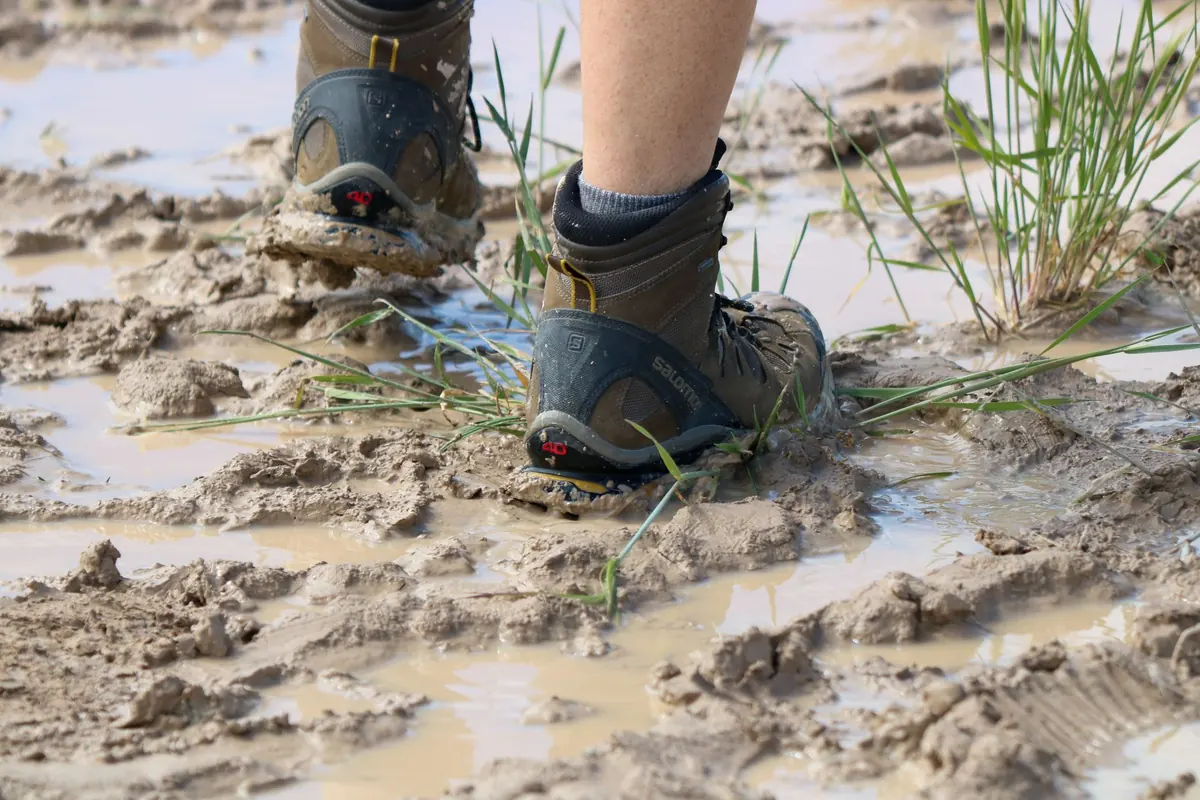
Grip on British ground is mostly about the rubber compound and the depth of the lugs. Deep, wide-spaced lugs clear mud and peat well but feel vague and squirmy on rock. Shallow, sticky soles hold on wet gritstone and limestone but skate across a muddy field gate.
Think about where you actually slip. Wet rock slabs on a Lakeland descent, wet grass on a Dales hillside, greasy wooden stiles and boardwalks, polished limestone in the Mendips. Soft rubber grips best when it is cold and wet, but it wears down quickly on abrasive rock, and worn lugs are the single most common cause of a slip on wet grass. Check yours before a big day out.
Ankle support: honesty over marketing
A high cuff limits how far your ankle can roll, and that is a genuine benefit when you are carrying a heavy pack over boulder fields or pathless ground. But a stiff collar is not a guarantee. Much of your stability comes from the sole platform, how well the shoe fits, and your own ankle strength and balance. Plenty of people have rolled an ankle in a tall boot.
Trail shoes let the ankle move and, over time, encourage it to do more of the work. On well-made paths that is fine and often more comfortable. On loose scree, wet rock and tussocky moorland, many walkers want the extra coverage.
When boots earn their place
- Any day with a heavy pack — camping kit, climbing gear, a full winter load
- Rough, pathless ground: boulder fields, scree, heather and tussocks
- Winter hills, or anywhere you might need crampons (most need a stiff sole)
- Long days in cold, wet conditions where warm dry feet matter more than weight
- A history of ankle sprains, or ankles that have never felt reliable
When trail shoes win
- Summer low-level walks, estate tracks, canal towpaths and waymarked trails
- Fast and light days where you want to move quickly and sweat less
- Routes with stream crossings or lots of wet grass, where quick-drying beats waterproof
- Anyone who rarely rolls an ankle and finds boots clumsy on descents
Waterproofing and breathability
A waterproof boot or shoe uses a membrane to keep rain and wet grass out. It works well — until water comes in over the top, or the membrane gives up. Then it holds water in, and you are carrying a sodden weight for the rest of the day. A failed waterproof boot is worse than a shoe that never claimed to be waterproof at all.
Non-waterproof trail shoes soak through quickly but drain and dry fast. On a warm wet day with a couple of stream crossings, that is often the more comfortable option. In January, on peat bogs and long wet grass, waterproof boots and a pair of gaiters are worth every gram.
Look after whatever you buy. Rinse mud off after each walk, reproof leather with wax or conditioner, and dry everything at room temperature, away from radiators, fires and tumble dryers. Heat shrinks and cracks leather and can delaminate membranes.
Matching the shoe to the route
Most UK day walks sit somewhere on a spectrum. Rough guide:
- Muddy lowland paths, river meadows, farmland: trail shoes with deep lugs.
- Rocky ridges and scree in Eryri or the Lakes: boots, or a stiff mid-cut shoe.
- Peat bogs and open moorland: boots plus gaiters, whatever the forecast.
- Long-distance trails on firm surfaces: trail shoes, for comfort over distance.
- Winter hills with snow and ice: boots with a sole stiff enough for your crampons.
- Coastal paths with stretches of road: lighter, more cushioned shoes.
Fit, socks and the details that matter more
Fit beats category every time. You want roughly a thumb's width between your longest toe and the front of the shoe, a heel that stays locked when you kick a step, and enough width that your toes can spread. Try footwear on in the afternoon, when feet are slightly swollen, and wear the socks you actually walk in.
Choose wool or wool-blend socks and leave cotton at home — it holds water against the skin and is a reliable route to blisters. Leather boots need a few short walks to break in; modern synthetic shoes need very little. If you are prone to blisters, address them before the walk with a decent insole, a lacing tweak or tape on hot spots. Anyone with persistent foot or ankle pain should see a podiatrist or physiotherapist rather than hoping new boots will fix it.
How to decide
Before you buy, answer these five questions honestly:
- What is the roughest ground on the walk I do most often?
- How heavy is my pack likely to be?
- Am I usually out in summer showers, or in all-day winter wet?
- Have I rolled or twisted an ankle in the last two years?
- Can I walk ten miles in what I already own without thinking about my feet?
If those answers point in different directions, buy for the walk you do most, not the one you daydream about. For most low-level UK day walks, a good trail shoe is plenty. The rougher, wetter, colder and heavier the day gets, the more a boot earns its keep. And if you are heading onto a hill in poor conditions with a big pack, take the boots — your ankles will thank you on the descent.
Photo: GregMontani / Pixabay

Three Days on the West Highland Way: Trip Report and Packing Tips
A three-day fastpack of the West Highland Way, with notes on where the pace fell apart and which kit...

A Winter Ascent of Snowdon: Trip Report and Lessons Learnt
A cold, clear winter day on Yr Wyddfa via the Llanberis Path, with the kit that earned its place and the...
About Us